
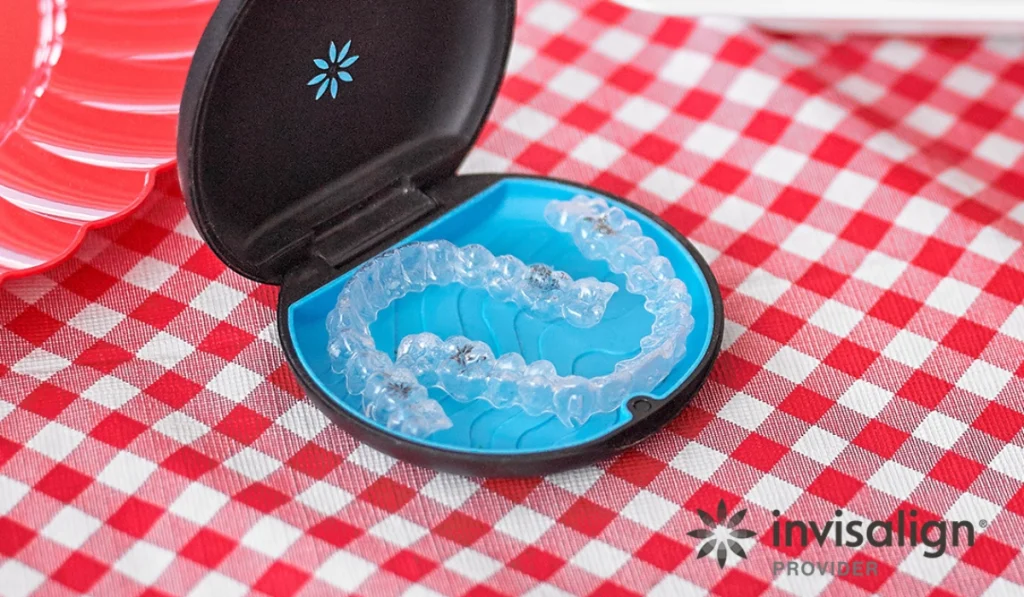
Many patients wonder how clear aligners can straighten teeth without metal brackets and wires. The process involves fascinating biological mechanisms that an Invisalign dentist carefully orchestrates. Understanding the science behind tooth movement helps patients appreciate the precision of clear aligner therapy. This knowledge also explains why following treatment guidelines is so important for achieving optimal results.
How Your Invisalign Dentist Applies Controlled Force
Tooth movement relies on controlled force application to specific areas of each tooth. An Invisalign dentist uses advanced software to plan exactly how much force each tooth needs.
Key principles of force application include:
- Each aligner moves teeth approximately 0.25 to 0.33 millimeters
- Aligners apply gentle, consistent pressure to move teeth into desired positions
- Force is applied in specific directions and magnitudes for each tooth
- The progression allows bone tissue time to remodel properly
The clear aligners work through a process called bone remodeling. When pressure is applied to a tooth, it creates compression on one side. This compression triggers specialized cells called osteoclasts to break down bone tissue. On the opposite side, tension stimulates osteoblasts to build new bone tissue.
This biological process allows teeth to move through the jawbone safely. An Invisalign dentist understands these mechanisms and plans treatment accordingly. The precision of force application sets clear aligners apart from other orthodontic methods.
Why Gradual Pressure Changes Work Better
Traditional braces often apply stronger forces that can cause discomfort and slower movement. An Invisalign dentist uses a different approach based on biological research.
Benefits of gradual pressure include:
- Reduced patient discomfort throughout treatment
- More predictable and controlled biological response
- Faster tooth movement compared to heavy, intermittent forces
- Lower risk of tissue damage or hyalinization
- Fewer mid-treatment adjustments needed
Excessive force can actually slow down tooth movement or cause damage. When too much pressure is applied, blood flow to the periodontal ligament becomes restricted. The Invisalign dentist avoids this problem by using lighter, more consistent forces.
Research shows that light, continuous forces produce faster tooth movement than heavy forces. The Invisalign dentist leverages this scientific principle to optimize treatment timelines.
The Role of Attachments in Invisalign Dentist Treatment
Attachments are small, tooth-colored bumps that an Invisalign dentist bonds to certain teeth. These strategic additions enhance the aligners’ ability to move teeth in specific ways.
How attachments work:
- Act as handles that give aligners better grip on teeth
- Placed in precise locations based on desired tooth movement
- Provide leverage needed to rotate teeth around their vertical axis
- Enable vertical movements like extrusion or intrusion
- Made from tooth-colored composite material that blends naturally
- Easily removed once treatment is complete
Rotating teeth represents one of the most difficult movements in orthodontics. Attachments provide the leverage needed to turn teeth effectively. The Invisalign dentist designs attachment shapes specifically for rotation, extrusion, or intrusion movements.
Buttons and Elastics for Complex Movements
Some cases require additional tools beyond aligners and attachments. An Invisalign dentist may use small buttons and elastic bands for complex tooth movements.
When buttons and elastics are used:
- Correcting Class II and Class III malocclusions
- Addressing bite relationship issues
- Achieving optimal jaw positioning
- Comprehensive bite correction alongside tooth alignment
Buttons are similar to attachments but designed specifically for elastic placement. The Invisalign dentist bonds these small anchors to teeth where elastic force is needed. Elastics connect upper and lower teeth to correct bite relationships.
The combination of aligners and elastics allows for comprehensive bite correction. An Invisalign dentist can address both tooth alignment and jaw relationship issues simultaneously.
Precision Planning and Monitoring
Modern technology allows an Invisalign dentist to plan treatment with unprecedented precision. Digital scans create exact 3D models of teeth and surrounding structures.
Treatment planning features include:
- Virtual simulation of entire tooth movement sequence
- Preview of future smile before treatment begins
- Regular progress checks to ensure treatment stays on track
- Digital monitoring options for remote check-ins
- Prompt adjustments if teeth aren’t moving as planned
Patients can see a virtual representation of their future smile during the consultation. The Invisalign dentist reviews this plan and makes adjustments as needed.
Expert Invisalign Care at City Dental on Bay
For patients seeking expert clear aligner treatment, City Dental on Bay offers comprehensive Invisalign dentist services in downtown Toronto. Located at 1006 Bay Street, the practice combines advanced technology with personalized care. The experienced Invisalign dentist team at City Dental on Bay understands the science behind tooth movement. They apply this knowledge to every treatment plan. To learn more about how an Invisalign dentist can transform your smile, call City Dental on Bay at 647-957-2500 or email bay@city-dental-toronto.local.