
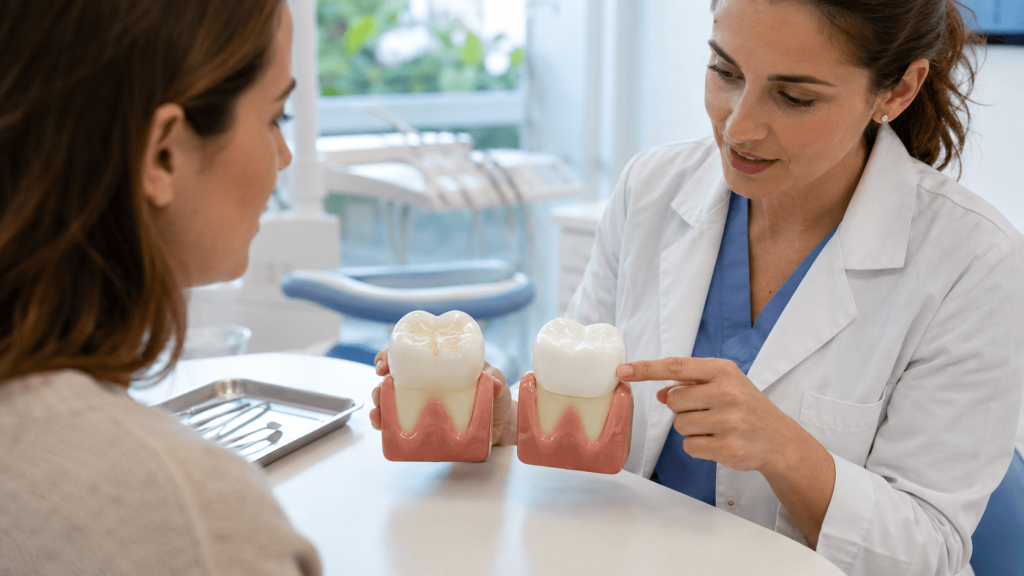
A filling is often used when enough healthy tooth structure remains to support a smaller repair. A dental crown may be recommended when a tooth needs more coverage or support because of extensive decay, damage, a large existing filling, or previous treatment. Neither option is automatically better.
Choosing between a dental crown vs filling requires an examination. Your dentist may also use X-rays and consider the amount of healthy tooth structure remaining, the location of the damage, bite forces, existing dental work, and the condition of the tooth.
What Is the Difference Between a Crown and a Filling?
A dental filling repairs a specific area of a tooth. The dentist removes the affected portion, prepares the area, and places filling material to restore the missing structure. Since a filling replaces only part of the tooth, it depends on the surrounding natural structure for support.
A crown covers more of the visible tooth above the gumline. It is shaped to restore the tooth’s form and function while providing coverage around the remaining structure. Before a crown is placed, the tooth must be prepared so the restoration can fit over it.
The main difference is the amount of coverage. A filling repairs a smaller area within the tooth, while a crown supports and covers a larger portion.
Both treatments fall within restorativegeneral dentistry. The appropriate choice depends on what the dentist finds during an examination rather than which option a patient prefers.
When a Dental Filling May Be Recommended
A filling may be considered when decay or damage is limited and enough healthy tooth remains to support the repair. This is often the case when a cavity affects a smaller area.
Fillings may also be used to repair certain chips, areas of wear, or damaged existing restorations. Suitability depends on the tooth’s location, the extent of the problem, and the forces placed on it when biting or chewing.
Before recommending a filling, the dentist may consider:
- How much healthy tooth structure remains
- The size and location of the affected area
- Whether the tooth has cracks or fractures
- The condition of any existing filling
- The pressure the tooth receives during biting
- The patient’s oral health and dental history
A filling is not always appropriate simply because it is a smaller restoration. If too much tooth structure has been lost, a large filling may not provide the support the tooth needs. The dentist must assess whether the remaining structure can hold the restoration and tolerate normal biting forces.
Routine examinations can also help identify changes in existing fillings or areas of decay that may not yet be causing obvious symptoms.
When a Dental Crown May Be Recommended
A dentist may recommend a crown when a tooth requires more coverage or support than a filling can provide. This could be considered when a large portion of the tooth is damaged, decayed, weakened, or already occupied by an extensive filling.
Crowns may also be discussed for teeth that have undergone root canal treatment, depending on the tooth and its condition. A crown is not automatically required in every situation. The recommendation should be based on the remaining structure, the tooth’s position, and the forces it receives.
A crown may be considered for:
- A tooth with extensive decay
- A large or failing existing filling
- Significant loss of natural tooth structure
- A cracked, weakened, or fractured tooth
- A tooth that has received previous treatment
- Damage that may not be suitable for a filling alone
The purpose of a crown is not to make a tooth indestructible. Like natural teeth and fillings, crowns still require daily care and regular dental examinations.
Some practices use modern restorative systems to create certain crowns efficiently. City Dental on Bay provides information aboutsame-day crown technology, but the restoration recommended and the time required depend on an assessment. Same-day treatment should not be assumed or guaranteed.
Why Tooth Structure Matters
The amount and quality of healthy tooth structure remaining are central to the decision between a crown and a filling. Every restoration needs a suitable foundation.
A tooth with a small area of decay surrounded by strong natural structure may be repaired with a filling. If the affected area is larger, the walls around it may be too thin or weakened to support another filling reliably.
The size of an old filling also matters. A tooth with a large restoration may have less natural structure available than it appears to have from the outside. If the filling loosens, breaks, or develops decay around its edges, the dentist must assess both the restoration and the remaining tooth.
Location also affects the decision. Teeth toward the back of the mouth typically handle substantial chewing forces. A repair that may be appropriate for one tooth may not be recommended for another because of differences in position, structure, or bite pressure.
Preserving natural tooth structure is an important goal, but the smallest restoration is not always the most appropriate. The dentist must balance preservation with the amount of support and coverage the tooth may need.
How Your Dentist Decides Between a Crown and a Filling
Symptoms alone cannot reliably show whether a person needs a dental crown or filling. Sensitivity, discomfort while chewing, or a rough edge may have several possible causes. Some damaged teeth produce few noticeable symptoms.
The assessment may include a visual examination, a review of the patient’s dental history, and X-rays when appropriate. The dentist may also evaluate the tooth’s existing restorations, surrounding tissues, bite, and response to clinical tests.
The recommendation may be influenced by:
- The depth and location of decay
- The size and condition of an existing filling
- Evidence of cracks or structural weakness
- The amount of healthy tooth remaining
- The tooth’s function and position
- Previous treatment involving the tooth
- The condition of the surrounding teeth and gums
A dentist may determine that neither a filling nor a crown is appropriate. A different treatment or further evaluation could be needed, depending on the diagnosis.
City Dental on Bay offers a range ofdental services in Downtown Toronto for different oral health needs. An assessment allows the dentist to explain which options may be relevant without assuming every damaged tooth requires the same solution.
What to Ask Before Restorative Dental Treatment
Understanding why a treatment has been recommended can make the decision easier. Patients should feel comfortable asking questions before proceeding.
Helpful questions include:
- What did the examination or X-ray show?
- How much healthy tooth structure remains?
- Why are you recommending a filling or crown?
- Are there other reasonable options?
- What could happen if I delay treatment?
- What does the proposed treatment involve?
- How should I care for the restoration?
- What is included in the estimated cost?
- Could the plan change during treatment?
Cost can differ depending on the tooth, restoration, materials, treatment needs, and what the fee includes. A broad search for dental crown cost in Toronto cannot replace a personalized estimate.
Patients can also ask whether their insurance may contribute to treatment. Coverage varies, so reimbursement should not be assumed or promised.
Frequently Asked Questions About Dental Crowns and Fillings
Is a crown better than a filling?
A crown is not automatically better than a filling. Each is intended for different restorative needs.
A filling may be appropriate when the affected area is limited and enough healthy structure remains. A crown may be recommended when the tooth needs broader coverage or support. The better option is the one suited to the tooth after an examination.
Can a filling turn into a crown later?
A filling does not physically turn into a crown, but a tooth with a filling may need a crown later. This could happen if the filling becomes damaged, decay develops around it, the tooth cracks, or more natural structure is lost.
Needing a crown later does not necessarily mean the original filling was the wrong treatment. Teeth and restorations can change over time.
Does a cracked tooth always need a crown?
No. Treatment depends on the crack’s location, depth, symptoms, and effect on the tooth’s structure. Some cracks may be managed with a restoration, while others require a different approach.
A crack cannot be diagnosed accurately from symptoms or appearance at home. Anyone who suspects a cracked tooth should arrange an assessment.
How do I know if my filling is failing?
Possible signs include new sensitivity, discomfort when biting, a rough edge, a visible crack, food catching around the tooth, or part of the filling becoming loose. However, a deteriorating filling may not always cause noticeable symptoms.
These signs do not confirm that the filling is failing or that a crown is required. A dentist needs to examine the tooth and may recommend X-rays to identify the cause.
Can a dental crown be done quickly?
The time required depends on the tooth, the planned restoration, the dental office’s workflow, and the patient’s clinical needs. Certain systems may allow some crowns to be completed more efficiently, but same-day treatment is not appropriate or available in every situation.
A dentist can explain the expected process after examining the tooth. Patients should not assume a specific timeline or appointment availability based on online information.
Talk to City Dental on Bay About Restorative Dental Care
A filling may be suitable when a tooth has enough healthy structure to support a smaller repair. A crown may be considered when broader coverage or support is needed. The decision depends on the tooth’s condition, not simply which treatment sounds preferable.
If you have a painful, damaged, cracked, sensitive, or previously filled tooth, City Dental on Bay can assess it and discuss the findings. Patients living or working near Bay Street canbook an appointment for restorative dental care in Downtown Toronto. A filling, crown, or another treatment can only be recommended after an appropriate examination.